How to Choose a Commercial Vegetable Cutting Machine (Buyer's Guide)
This guide is for the person who has to sign the cheque: the hotel that prepares breakfast for three hundred, the restaurant getting through sacks of onion before every service, the caterer cutting for a wedding, and the cloud kitchen with two square metres of prep space and no room for a third pair of hands. It covers the four things that decide whether a vegetable cutting machine pays for itself — capacity, motor, blades and cleaning — and what each of them costs in practice.
The arithmetic is simple. Two kitchen hands spending two hours a day chopping is roughly 120 hours a month of paid labour, before anyone slices a thumb. A machine does that work in twenty minutes. The question is not whether to buy one, but which size stops you overpaying for capacity you never use.
Which machine suits your business size
Size your machine by the weight you cut, not by the number of seats. Weigh what a normal day's prep actually is — onion, carrot, cabbage, potato, all of it — and match it to a rated capacity with room to spare, because rated figures assume continuous feeding by someone who is not also answering the phone.
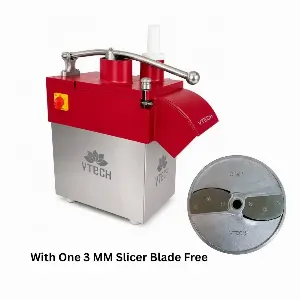
- Small restaurant, tiffin centre or cloud kitchen — up to about 50 kg a day. A compact slicer is enough. Our Vegetable Cutting Machine Pro is rated at up to 150 kg per hour with a 1 HP copper motor and a 3 mm slicer blade, on ordinary 220 V single-phase power. For a kitchen chopping 40–50 kg a day, that is a morning's work done before the first order.
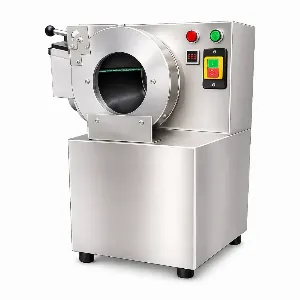
- Busy restaurant or mid-sized hotel — 100 to 300 kg a day. Step up to the 150–400 kg/hour class, such as the Vtech Mini Vegetable Cutting Machine (0.75 kW). The larger motor matters more than the headline capacity: it is what stops the machine labouring when somebody feeds it a full hopper of wet cabbage.
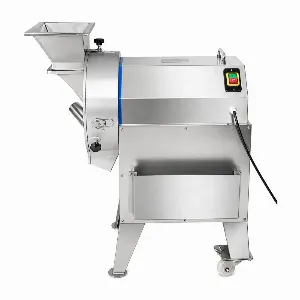
- Large hotel, canteen or catering kitchen — 300 kg a day and upwards. The V CUT Standard Vegetable Cutter is rated 200–800 kg/hour on a 2.2 kW motor. At this size you are buying duty cycle, not speed: the ability to run for an hour without stopping.
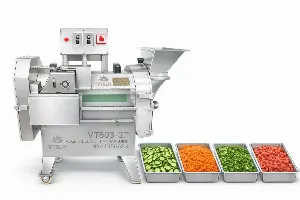
- Continuous production — central kitchens, chips and pickle units. A conveyor machine such as the Vegetable Cutting Machine with Conveyor (1.5–2 HP, food-grade stainless steel) feeds itself, so one person loads while the machine keeps cutting. Below roughly 300 kg a day a conveyor is capacity you are paying for and not using. [VERIFY: the volume at which your customers typically move to a conveyor.]
Electric vs manual vegetable cutting machines
Hand-operated cutters still have a place — a single cook, one vegetable, no power point — but they stop scaling the moment prep passes about 20 kg a day.
| Manual | Electric | |
|---|---|---|
| Speed | Roughly 10–20 kg an hour, and it falls as the operator tires [VERIFY] | 100–800 kg an hour depending on model, and it does not tire |
| Cost to buy | A few thousand rupees [VERIFY PRICE] | From about ₹19,500 for a compact slicer to ₹1,36,000 for a conveyor machine (our current prices) |
| Running cost | Labour — the real expense | Electricity plus blade replacement; the labour it saves is the point |
| Maintenance | Sharpen or replace the blade; almost nothing else | Daily wash-down of blades and hopper, periodic motor and belt check |
| Consistency | Varies by operator | Every slice the same thickness — which is what a customer notices |
| Best for | Home kitchens, single-dish stalls, back-up when power fails | Any kitchen where prep is a scheduled job with a deadline |
Key specifications to check
Five things decide whether the machine is still working in five years.
- Motor power and type. Ask for the rating in kW or HP and whether the winding is copper. Copper windings run cooler and survive the daily stop-start of a kitchen; the machines above are 0.36 kW to 2.2 kW, all on 220 V single phase. Match the motor to your connection before it arrives, not after.
- Blade material and the blade set. Stainless steel blades, and more than one of them. Slicing, dicing and shredding are different blades on the same machine. Confirm which are included and what a spare costs — blades are a consumable, not a one-time purchase.
- Rated capacity, honestly read. A "400 kg/hour" figure is a laboratory number with continuous feeding. Plan on comfortably under it.
- Body material. Food-grade stainless steel where wet vegetable matter touches metal. Painted mild steel is cheaper and rusts at the first chip.
- Safety. A feed hopper deep enough that hands cannot reach the blade, a cut-off that stops the motor when the lid opens, and a stable base. These are the details that separate a commercial machine from a scaled-up domestic one. [VERIFY: which safety interlocks each model carries.]
Price ranges in India
The prices below are ours, live from this catalogue on the day this guide was written. Treat other quotes with suspicion if they are far under: the saving is usually the motor or the steel. [VERIFY PRICE: confirm each figure before you promote this page, and re-check when prices change.]
- Compact slicer, up to 150 kg/hour — from about ₹19,500 [VERIFY PRICE]
- Mini machine, 150–400 kg/hour — about ₹56,000 [VERIFY PRICE]
- Standard cutter, 200–800 kg/hour — about ₹85,000 [VERIFY PRICE]
- Conveyor machine, continuous duty — about ₹1,36,000 [VERIFY PRICE]
Budget separately for a spare blade set and for delivery to your city. [VERIFY: delivery and installation charges outside Coimbatore, and whether installation is included.]
Maintenance and cleaning tips
- Strip it every night. Blades, hopper and outlet chute come off for washing. Dry them before reassembly — standing water is what pits stainless steel over a season.
- Never hose the motor housing. Wipe it. Water driven into a winding is the most common way these machines die, and it is not a warranty matter.
- Watch the sound. A motor that hums under a load it used to take easily has a blunt blade or a slipping belt. Both are cheap now and expensive after another month.
- Keep a spare blade set. A blunt blade tears onion instead of slicing it, and the difference shows on the plate.
- Feed it properly. Even quantities, no stones, no frozen blocks. Most broken blades arrive with something that was never a vegetable.
Frequently asked questions
What capacity do I need for a 100-seat restaurant?
Work from your prep volume, not your seat count. A kitchen cutting 40-60 kg of vegetables before each service is comfortable on a 150-400 kg/hour machine, because the rated figure assumes continuous feeding and an even mix. If two people currently spend two hours chopping every morning, that is the job you are replacing.
Can one machine cut onion, carrot, cabbage and potato?
Yes, but not with one blade. Slicing, dicing and shredding are different blade sets on the same machine, and you change the blade for the job. Onion is the awkward one: it is soft and layered, so a blunt or wrongly chosen blade tears it rather than cutting it. Ask which blades are in the box and what a spare costs before you buy.
Does a commercial vegetable cutter run on ordinary single-phase power?
The machines on this page run on 220 V single phase, which is what a normal commercial kitchen connection provides. Larger conveyor machines can be specified with bigger motors, so confirm the motor rating against your connection and your load before ordering [VERIFY: three-phase options and their ratings].
How long does cleaning take at the end of service?
Budget ten minutes. Blades, the feed hopper and the outlet chute come off without tools on a well-designed machine, and they are the parts that must be washed and dried every day. A machine that needs a spanner to reach its blades will not be cleaned properly once the kitchen is busy.
Is stainless steel worth the extra cost over a painted body?
In a kitchen that washes down daily, yes. Food-grade stainless steel does not rust where the paint chips, and it is the surface a food inspector expects to see against wet vegetable matter. Painted or mild steel bodies are cheaper to buy and cost more to keep.
Ready to choose?
If you are cutting under 50 kg a day, start with the Vegetable Cutting Machine Pro. Above that, tell us what you cut and how much of it, and we will tell you which of these machines fits — including when the cheaper one is the right answer.
See the Vegetable Cutting Machine Pro Compare every cutting machine